
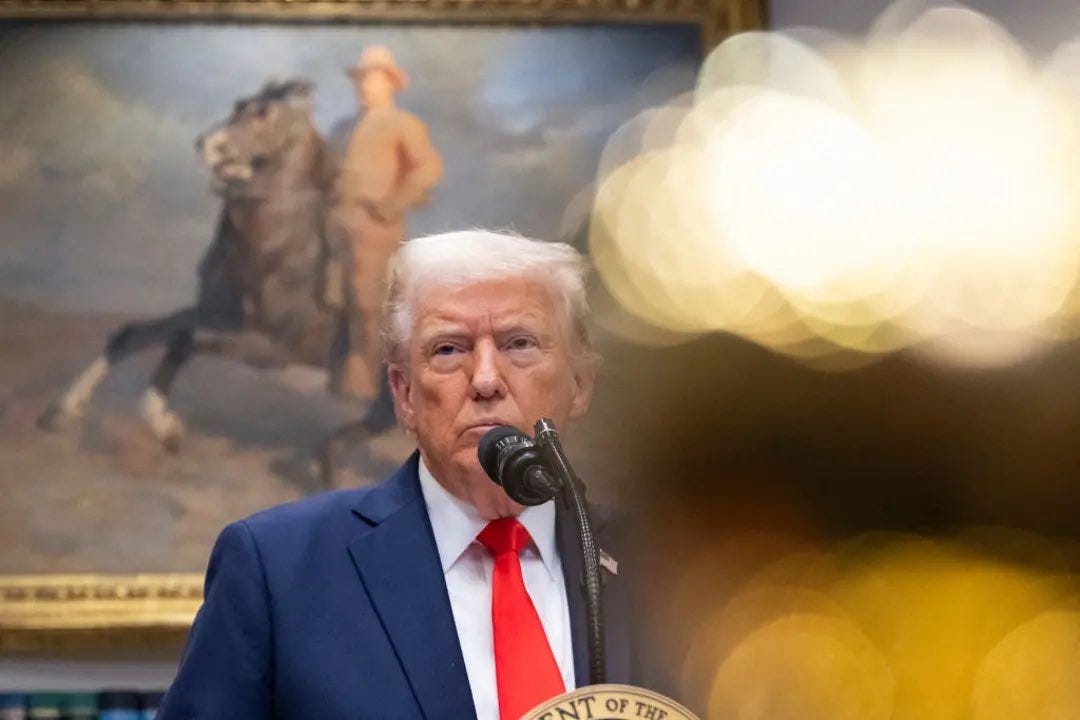
The second Trump presidency is embedding a new regime, in Stephen Skowronek’s parlance, in American politics. While many continue to debate how to place Trump in political time, that being the time which measures “the years that unfold between periodic resets of the nation’s ideological trajectory,” it can be discerned from his approach to executive governance during the second term thus far that Trump 2.0’s is a reconstructive presidency. By which we mean, Trump is repudiating, rhetorically and institutionally, the conservative insurgency of Ronald Reagan—the last president to reset political time and institute a new regime, which has defined the nation’s ideological trajectory up to this point.
The ideology underpinning the Reagan regime, which lasted from the 1980s until it eventually ran out of steam under the presidency of Joe Biden (2021-2025), was fundamentally liberal. This regime was defined by the promotion and institutionalization of global free trade, deregulation at home, a highly interventionist foreign policy, and the internalization of the dogma that American identity was not fixed to a certain people or place, as JD Vance proclaimed it is, but that anybody born anywhere in the world could become an American simply by proclaiming that they believed in a set of liberal values. Since America’s primary adversary collapsed not long after Reagan left office, and America was globally preponderant in its power and reach at the unipolar moment, his mythification in American politics had, for the majority of the post-Cold War era, seemingly validated the ideology and politics he represented. This is why every one of his successors, even those from the opposite party, as Skowronek himself has shown, “has been subject to political expectations that he set; everyone has tested and manipulated standards that he established.” For example, a major issue for George H.W Bush, Reagan’s “articulator,” in sustaining his leadership authority was the difficulty of defining himself in relation to Reagan’s overbearing shadow in foreign and domestic policy; ultimately, his perceived betrayal of the Reagan Revolution, through his raising of taxes and advancing a pragmatic yet unlofty form of (small ‘C’) conservatism, contributed to his declining support amongst conservatives.
In order to appeal to a polity who had been captured by the Reagan regime, Bill Clinton and his New Democrats sought to shift the Democratic Party away from its insistence on pacifism abroad and social programmes at home, such as welfare, to reshape the party in accordance with the changes in American politics and economics made by Reagan; leading Jack Godwin to write How Bill Clinton Reengineered the Reagan Revolution by further modernizing the federal government through outsourcing, more budget cuts, as well as continuing Reagan’s deregulatory trajectory vis a vis Wall Street which ended up making big banks “too big to fail.” George W. Bush has been characterized as an “orthodox innovator” who sought to broaden the appeal of the dominant conservative regime to those on the supposed opposite side of the political through constructing new and broader appeals to conservativism, a “compassionate conservatism,” as they called it back then. Thus, Lou Cannon referred to Bush as Reagan’s Disciple.
However, just as Skowronek, the progenitor of the “regime cycle theory” of presidential history, posited was the case with Reagan and his repudiation of FDR’s new deal liberalism (which was the paradigmatic ideology of U.S. national politics until eventually it could no longer be rejuvenated and its legitimacy waned during Jimmy Carter’s years of malaise), Trump’s second term leadership represents something wholly unexpected. And, like Reagan, Trump came into office, in both his first and second terms, on a platform that recalled the great reconstructive crusades of presidential history. Like Reagan, and other reconstructive presidents, and especially during Trump’s first term (2017-2021), Trump met with stiff institutional resistance to his order-shattering authority within “an ever thicker government that can parry and deflect more of their repudiative thrust.”
